![[personal profile]](https://www.dreamwidth.org/img/silk/identity/user.png) thekusabishat
thekusabishatVolume 2. Mostly about FF2 and its spirit list (still waiting on FF1; will get on it ASAP once it arrives. I do hope there are interesting things in that, too - I don't expect to be let down.)
Fatal Frame II
*The term used to mean the Twin Shrine Maiden's "other half" is 片割れ (kataware), meaning "a piece/half of" or "one member of (a pair or group)". This is used in the title of Chapter 8, Half Moon - Katawarezuki.
*All Gods' Village (皆神村 Minakami-mura) is underwater by the end of the game - the dam is called 水神ダム, or Minakami dam (Minakami meaning "water god"), using different kanji with the same reading.
*Spirit Stone/Orbs - known as nenju in Japanese. These are Buddhist prayer beads or (thought beads) - hence their in-game appearance. The word (念珠) is made up of 念 (nen - thought, derived from 念ずる - nenzuru - to pray or think silently) and 珠 (ju - gems, pearls or beads).
*The Crimson Ball is, more specifically, a type of temari.
Keys
Many of the keys in FF2 have the designs of family crests engraved on them:
*The Hammer Key has the design (and name) of a family crest - examples of it can be seen here (those containing 八 in their names - more specifically, 八つ槌車1 seems to be the exact design). It seems relatively new, the earliest sample apparently recorded in the Edo period. It supposedly depicts wooden mallets. It's called "tsuchi" (槌), just like in the Tsuchihara family name, but I don't know they're related in any way.
*A similar case is the Diamond Stack Key, an image of which you can see in the black and white example table of crests in the middle of this page, second to last on the bottom. It's represented by three stacked diamonds, as the name suggests.
*Diamond Link Key - see here. Apparently a spool of thread wound around a loom. Relatively rare crest, and said to have ancient & honourable origins, around since at least the Fujiwara period (898–1185).
*Light & Shadow Keys - may be a reference to this, Chigaibishi (違い菱 - different diamonds), two interlocking diamonds.
*Ginger Key - the Myouga (茗荷 - Japanese ginger) crest. It's considered to be a good omen and sign of blessings from the gods, and as such is used at many shrines and temples.ref
*The Octagon Key appears to be similar to 組み合い角に桔梗 (Kumi-ai kaku ni kikyou) here.
*The design on the Paulownia key follows the Kiri (paulownia) family of designs.
A number of Japanese - English spirit list inconsistencies, notes and differences:
*The English version of the Spirit List (and Japanese guidebook) wrongly states that the Twin Doll is possessed by Azami's spirit - for example, #82 Dazed Doll - "Contains soul of twin". This mistake does not occur in the Japanese original (which translates to "Staring Doll"), which says "A soul dwells within, and it became a corpse." (躯 (mukuro) meaning "corpse" or "dead body".) To whom the soul belongs is never mentioned.
*#105 Roaming Doll is actually called さまよう人影 (Samayou Hitokage - Wandering Figure/Shadow), the ghost of someone who became trapped in the darkness. It has nothing to do with a doll.
*118 Frozen Woman - this does actually refer to her inability to move (動けなくなった女 - Ugokenakunatta Onna, Unmoving/Trapped Woman) rather than cold or anything like that. The Japanese list states that she was too afraid and sick to even get out of the futon she was in, which may explain the "lumpy" futon you find Miyako's diary in during Chapter 1.
*#120, Shrine Shadow (Child in the Shadow of the Shrine in Japanese) was a child who was playing near the shrine. In English, his entry reads "Was hiding in his usual spot when Malice came out of the deep below the shrine." His Japanese entry says "神社の深道を通って来た瘴気" - the word interpreted as "deep below" in this case is 深道, which is the Japanese name of the Underground Passageway.
*#124 Garden Woman - specifically stated in Japanese that she killed herself when the Repentance happened. She chose the spot because of the man she loved, something not specifically mentioned in English. Whether or not they were actually lovers is unclear (it says "suki datta otoko" - man she liked/loved - rather than "koibito", which actually means lover(s), and is used for people such as Miyako and Masumi).
*#128 Shivering Woman - Japanese list states that she actually witnessed the massacre in the Great Hall and fled to the Kiryu House.
*Some entries, such as #130 Fallen Woman, speak of "drinking" Malice - the word used, のまれ ("nomare", written in hiragana only; can also be spelt 飲まれ) can also mean "to be engulfed by or covered in", which is a more likely scenario.
*#133 Crushed Men - specifically noted to be Mourners.
*#134 Photo Woman - 過去の償で命を落とした女の霊 - "Ghost of a woman who lost her life in a past atonement." This is stated to be a "past ceremony" in English. The word meaning "atonement" is 償 - tsugunai. The Japanese word for the Repentance is 大償い or Oo-tsugunai - a big atonement. There was possibly a similar yet much smaller Repentance-type disaster at some point in the past.
*#136 Storehouse Woman - Yae. Name not mentioned in English. Stated to be Yae's residual thoughts.
*#141 Sae Kurosawa - "Waits for her sister. She has gone crazy, but will never forget her sister." in English. "Sae, waiting in her room for her sister. Even though she has gone mad, in the bottom of her heart she waits forever for her sister's return."
Fatal Frame III
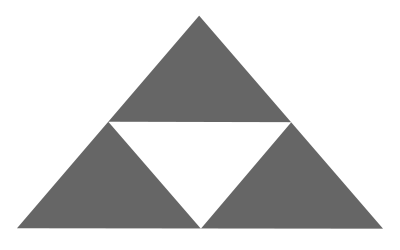
*The Houjou family crest, known as the Mitsu Oroko (three scales), is associated with the tattooed priestess in Yuu's notes in the FF3 guidebook. Said by Yuu to be derived from the scales left behind by the priestess, symbolising the close relationship between priestess and snake. In reality, the crest is thought to be interpreted as a representation of fish or dragon scales due to the pattern of continuous triangles resembling a scaled body.ref
*Purity Stones are Pacifying/Calming Stones in Japanese (since they play the pacifying lullaby sung by the pacifying girls).
Keys:
*Dianthus Key is a pretty standard dianthus.
*Notched Arrow Key is another crest - 違い矢筈 (Chigai Yahazu), design two.
*Two Mandarins Key - I don't know what this refers to. The literal translation is "facing/opposite bridges".
Fatal Frame II
*The term used to mean the Twin Shrine Maiden's "other half" is 片割れ (kataware), meaning "a piece/half of" or "one member of (a pair or group)". This is used in the title of Chapter 8, Half Moon - Katawarezuki.
*All Gods' Village (皆神村 Minakami-mura) is underwater by the end of the game - the dam is called 水神ダム, or Minakami dam (Minakami meaning "water god"), using different kanji with the same reading.
*Spirit Stone/Orbs - known as nenju in Japanese. These are Buddhist prayer beads or (thought beads) - hence their in-game appearance. The word (念珠) is made up of 念 (nen - thought, derived from 念ずる - nenzuru - to pray or think silently) and 珠 (ju - gems, pearls or beads).
*The Crimson Ball is, more specifically, a type of temari.
Keys
Many of the keys in FF2 have the designs of family crests engraved on them:
*The Hammer Key has the design (and name) of a family crest - examples of it can be seen here (those containing 八 in their names - more specifically, 八つ槌車1 seems to be the exact design). It seems relatively new, the earliest sample apparently recorded in the Edo period. It supposedly depicts wooden mallets. It's called "tsuchi" (槌), just like in the Tsuchihara family name, but I don't know they're related in any way.
*A similar case is the Diamond Stack Key, an image of which you can see in the black and white example table of crests in the middle of this page, second to last on the bottom. It's represented by three stacked diamonds, as the name suggests.
*Diamond Link Key - see here. Apparently a spool of thread wound around a loom. Relatively rare crest, and said to have ancient & honourable origins, around since at least the Fujiwara period (898–1185).
*Light & Shadow Keys - may be a reference to this, Chigaibishi (違い菱 - different diamonds), two interlocking diamonds.
*Ginger Key - the Myouga (茗荷 - Japanese ginger) crest. It's considered to be a good omen and sign of blessings from the gods, and as such is used at many shrines and temples.ref
*The Octagon Key appears to be similar to 組み合い角に桔梗 (Kumi-ai kaku ni kikyou) here.
*The design on the Paulownia key follows the Kiri (paulownia) family of designs.
A number of Japanese - English spirit list inconsistencies, notes and differences:
*The English version of the Spirit List (and Japanese guidebook) wrongly states that the Twin Doll is possessed by Azami's spirit - for example, #82 Dazed Doll - "Contains soul of twin". This mistake does not occur in the Japanese original (which translates to "Staring Doll"), which says "A soul dwells within, and it became a corpse." (躯 (mukuro) meaning "corpse" or "dead body".) To whom the soul belongs is never mentioned.
*#105 Roaming Doll is actually called さまよう人影 (Samayou Hitokage - Wandering Figure/Shadow), the ghost of someone who became trapped in the darkness. It has nothing to do with a doll.
*118 Frozen Woman - this does actually refer to her inability to move (動けなくなった女 - Ugokenakunatta Onna, Unmoving/Trapped Woman) rather than cold or anything like that. The Japanese list states that she was too afraid and sick to even get out of the futon she was in, which may explain the "lumpy" futon you find Miyako's diary in during Chapter 1.
*#120, Shrine Shadow (Child in the Shadow of the Shrine in Japanese) was a child who was playing near the shrine. In English, his entry reads "Was hiding in his usual spot when Malice came out of the deep below the shrine." His Japanese entry says "神社の深道を通って来た瘴気" - the word interpreted as "deep below" in this case is 深道, which is the Japanese name of the Underground Passageway.
*#124 Garden Woman - specifically stated in Japanese that she killed herself when the Repentance happened. She chose the spot because of the man she loved, something not specifically mentioned in English. Whether or not they were actually lovers is unclear (it says "suki datta otoko" - man she liked/loved - rather than "koibito", which actually means lover(s), and is used for people such as Miyako and Masumi).
*#128 Shivering Woman - Japanese list states that she actually witnessed the massacre in the Great Hall and fled to the Kiryu House.
*Some entries, such as #130 Fallen Woman, speak of "drinking" Malice - the word used, のまれ ("nomare", written in hiragana only; can also be spelt 飲まれ) can also mean "to be engulfed by or covered in", which is a more likely scenario.
*#133 Crushed Men - specifically noted to be Mourners.
*#134 Photo Woman - 過去の償で命を落とした女の霊 - "Ghost of a woman who lost her life in a past atonement." This is stated to be a "past ceremony" in English. The word meaning "atonement" is 償 - tsugunai. The Japanese word for the Repentance is 大償い or Oo-tsugunai - a big atonement. There was possibly a similar yet much smaller Repentance-type disaster at some point in the past.
*#136 Storehouse Woman - Yae. Name not mentioned in English. Stated to be Yae's residual thoughts.
*#141 Sae Kurosawa - "Waits for her sister. She has gone crazy, but will never forget her sister." in English. "Sae, waiting in her room for her sister. Even though she has gone mad, in the bottom of her heart she waits forever for her sister's return."
Fatal Frame III
*The Houjou family crest, known as the Mitsu Oroko (three scales), is associated with the tattooed priestess in Yuu's notes in the FF3 guidebook. Said by Yuu to be derived from the scales left behind by the priestess, symbolising the close relationship between priestess and snake. In reality, the crest is thought to be interpreted as a representation of fish or dragon scales due to the pattern of continuous triangles resembling a scaled body.ref
*Purity Stones are Pacifying/Calming Stones in Japanese (since they play the pacifying lullaby sung by the pacifying girls).
Keys:
*Dianthus Key is a pretty standard dianthus.
*Notched Arrow Key is another crest - 違い矢筈 (Chigai Yahazu), design two.
*Two Mandarins Key - I don't know what this refers to. The literal translation is "facing/opposite bridges".